
By Juliet Ezeh
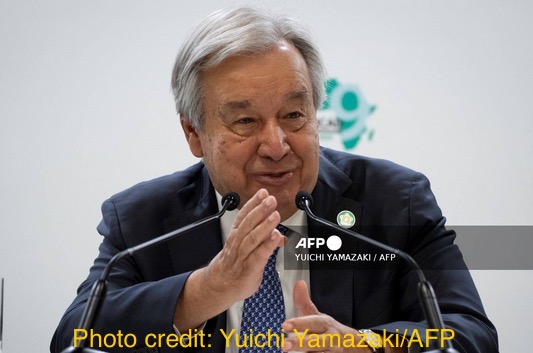
United Nations Secretary-General António Guterres has renewed calls for the full decolonisation of Western Sahara and 16 other territories that remain on the UN’s list of Non-Self-Governing Territories, urging member states to recommit to what he described as unfinished global business.
Addressing the 2026 session of the UN Special Committee on Decolonisation, widely known as the C-24, Guterres reminded delegates that the organisation was founded on the principle of sovereign equality among nations, not on hierarchies between rulers and the ruled.
More than six decades after the United Nations formally launched its decolonisation agenda, he noted that the work remains incomplete.
The Secretary-General emphasised that the effects of colonialism continue to reverberate across societies, shaping economic systems, political representation and social structures. He warned that legacies of exploitation, structural inequality and exclusion still influence global realities, underscoring the need for sustained diplomatic engagement.
The Special Committee on Decolonisation was established by the UN General Assembly in 1961 to oversee the implementation of the 1960 Declaration on the Granting of Independence to Colonial Countries and Peoples. Its mandate is rooted in Chapter XI of the UN Charter, which addresses territories that have not yet attained full self-government.
Since 1945, more than 80 former colonies with an estimated population of 750 million people have achieved independence. Yet 17 territories remain under review by the United Nations, collectively home to nearly two million people. Many of them are small island territories in the Caribbean and Pacific regions.
Among them, Western Sahara stands out as the only remaining territory in Africa still listed as non-self-governing, often described in diplomatic circles as Africa’s last colony.
Western Sahara was administered by Spain until 1976. Following Spain’s withdrawal, competing territorial claims and regional rivalries led to prolonged disputes involving Morocco, Algeria and Mauritania.
Today, roughly 70 per cent of the territory is administered by Morocco, while the Sahrawi Arab Democratic Republic maintains control over the remaining portion from a government-in-exile based in Tindouf, Algeria. The issue continues to generate diplomatic tensions within the African Union and the broader international community.
Guterres stressed that resolving each outstanding case requires a tailored approach grounded in international law, relevant General Assembly resolutions and the principles enshrined in the UN Charter. He called for inclusive dialogue involving administering powers, representatives of the territories concerned, UN member states and other stakeholders.
His remarks come amid renewed diplomatic efforts surrounding Western Sahara, including recent negotiations reportedly facilitated by former U.S. President Donald Trump, aimed at reducing hostilities and advancing a political solution.
For the United Nations, the decolonisation agenda remains a defining part of its identity. While significant progress has been recorded since the mid-20th century, the continued existence of non-self-governing territories highlights unresolved historical complexities.
As the C-24 begins another session, the central question persists: how to translate long-standing resolutions into concrete political settlements that reflect the will and rights of the people concerned.
The Secretary-General’s message was clear. Decolonisation is not a relic of history. It is an ongoing responsibility.