
By Juliet Ezeh
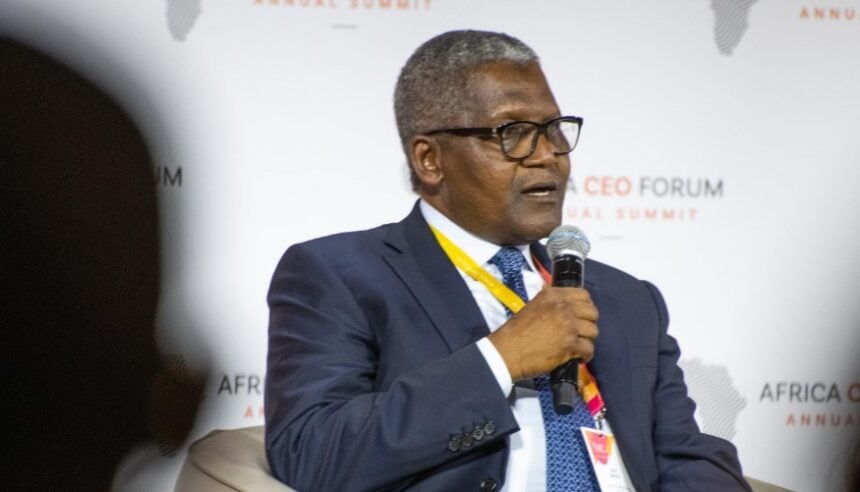
Africa’s richest industrialist, Aliko Dangote, has warned that Nigeria’s ambition to industrialise under the newly launched National Industrial Policy 2025 could falter unless the Federal Government urgently resolves the country’s chronic electricity challenges.
Speaking on Tuesday at the official launch of the National Industrial Policy 2025 in Abuja, Dangote urged the government to convene a high-level national retreat dedicated solely to fixing the power sector. According to him, stable electricity remains the single most important foundation for job creation, manufacturing expansion, and sustainable economic growth.
The event, themed “From Policy to Productivity: Implementing Nigeria’s Industrial Future,” brought together senior government officials, private sector leaders, and development partners. President Bola Tinubu was represented by Vice President Kashim Shettima.
Dangote acknowledged that recent policy reforms and incentives introduced by the administration were commendable, describing them as supportive of industrial growth. However, he maintained that incentives alone would not translate into productivity without reliable infrastructure, particularly electricity. He stressed that no country has achieved meaningful economic expansion without first resolving its power supply issues.
His remarks come at a time when Nigeria is grappling with recurring power disruptions. A recent five-day outage linked to gas supply maintenance activities triggered widespread blackouts across several parts of the country, affecting manufacturers and households alike. Seven power plants reportedly experienced gas constraints during the maintenance period, leading to generation shortfalls and intensified load shedding nationwide.
Industry stakeholders say such disruptions significantly increase production costs, as companies are forced to rely heavily on diesel-powered generators and alternative energy sources. Dangote noted that many factories now spend more on generating electricity than on actual production, a situation he described as unsustainable and counterproductive to economic growth.
Beyond electricity, the President of Dangote Industries Limited called for stronger protection of local industries against excessive importation and dumping. He argued that unchecked imports undermine domestic production and export jobs, warning that even generous incentives such as low-interest loans or free land would fail to stimulate growth if local manufacturers are not shielded from unfair competition.
Dangote also highlighted the dominant role of the private sector in Nigeria’s economy, noting that it accounts for the vast majority of the country’s Gross Domestic Product. He called for deeper collaboration between government and businesses, describing the relationship as a joint venture in which both parties must play their roles responsibly, including compliance with tax obligations.
On the broader economic outlook, Dangote expressed optimism that ongoing reforms have begun restoring investor confidence and stabilising the national currency. He projected that reducing import dependence and prioritising local manufacturing could further strengthen the naira while generating employment opportunities for millions of Nigerians.
Experts say the success of the National Industrial Policy 2025 will depend largely on whether structural bottlenecks especially in the power sector are addressed decisively. As Nigeria positions itself as a potential manufacturing hub in Africa, stakeholders argue that uninterrupted electricity supply will determine whether policy aspirations translate into real industrial productivity.