
By Juliet Ezeh
The Federation Accounts Allocation Committee approved the disbursement of N7.895bn for the operations of the Secretariat of the National Economic Council in 2025, even as several Ministries, Departments and Agencies continue to raise concerns over inadequate funding and poor capital releases.
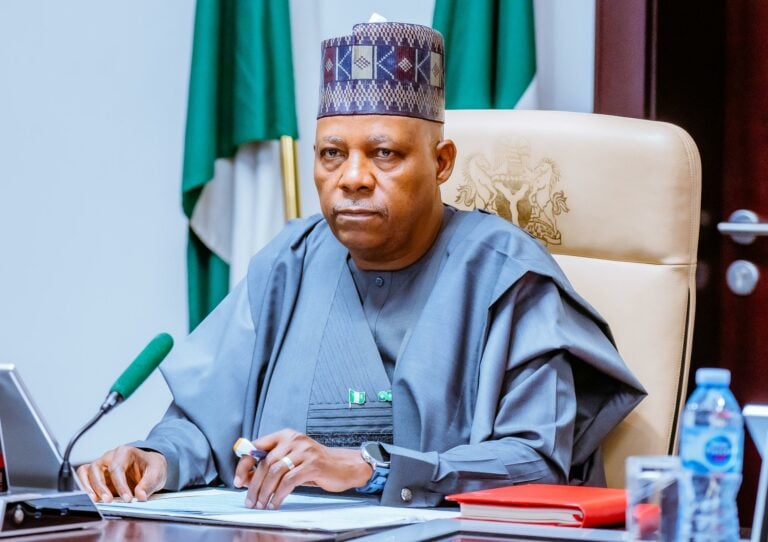
Documents obtained by Saturday PUNCH indicated that the fund was drawn from the 0.5 per cent Stabilisation Fund Account as of December 2025 and was approved by the Vice President and Chairman of the National Economic Council, Kashim Shettima.
The NEC Secretariat functions as the administrative and technical hub of the council, coordinating meetings between the Federal Government and state governors, conducting policy research, monitoring the implementation of council resolutions and facilitating collaboration on key economic and fiscal reforms.
According to the document titled Statement of 0.5 per cent Stabilisation Fund Account as at December 2025, the N7.895bn represented the full allocation approved for the secretariat’s operations for the 2025 fiscal year. The document also showed that the stabilisation account had a closing balance of N54.27bn during the same period.
Part of the document read, “The sum of N7,895,516,050.00 was approved by the Chairman of the National Economic Council for the operations of the NEC Secretariat for the year 2025 from the Stabilisation Fund. The closing balance in the account stood at N54,274,642,496.53.”
The approval comes at a time when many government ministries and agencies have expressed concern over shrinking fiscal space and delays in the release of funds needed to execute projects.
During the 2026 budget defence sessions at the National Assembly, several MDAs complained that low releases in 2025 significantly affected project implementation and service delivery.
The Federal Ministry of Health and Social Welfare revealed that capital releases in 2025 were extremely low. The Minister of Health, Muhammad Ali Pate, told lawmakers that only N36m was released from the N218bn approved for capital projects.
He said the situation weakened healthcare infrastructure and slowed the execution of critical health interventions at a time when the country faces rising public health challenges and increasing demand for medical services.
The Federal Ministry of Transportation also disclosed that it received only about one per cent of its N256.73bn allocation for 2025, amounting to roughly N2.57bn, warning that the shortfall stalled several rail, road and marine transport projects across the country.
Similarly, the Federal Ministry of Interior reported that it recorded zero capital releases in both 2024 and 2025, raising concerns about funding for immigration infrastructure, correctional facilities and internal security operations.
Lawmakers described the situation as unsustainable and called for urgent reforms to address the persistent gap between approved budgets and actual fund releases.
In the social sector, the Federal Ministry of Women Affairs also lamented poor disbursement patterns, noting that programmes targeting vulnerable women, children and internally displaced persons had been affected.
Security and intelligence agencies were not spared from the funding challenges. The House Committee on National Security and Intelligence described allocations to the intelligence community as inadequate, warning that the funding level does not reflect the Federal Government’s commitment to tackling security threats.
According to the committee, agencies within the intelligence sector, including the Office of the National Security Adviser and the Department of State Services, have struggled with delayed releases and limited operational funding.
Oversight institutions have also reported funding constraints. The Office of the Auditor-General for the Federation disclosed that only about four per cent of its 2025 capital allocation was released, limiting its capacity to effectively audit government institutions.
Lawmakers noted that the office, which is responsible for auditing more than 1,000 government entities, could not deploy modern auditing technology or expand its oversight operations due to funding limitations.
The approval of N7.9bn for the NEC Secretariat has therefore sparked debate among policy analysts and stakeholders over fiscal priorities, especially as many MDAs continue to struggle with limited resources needed to perform their mandates.
Analysts say the recurring gap between approved budgets and actual releases continues to weaken public spending efficiency and raises broader concerns about fiscal sustainability.
Nigeria’s fiscal space has remained under pressure due to rising debt service obligations, slow revenue growth and increased spending demands following the removal of fuel subsidy under President Bola Tinubu.
The National Economic Council, chaired by the Vice President and comprising state governors, serves as a key platform for coordinating economic policies between the Federal Government and subnational governments.
The Stabilisation Fund, from which the NEC Secretariat funding was drawn, is one of the special accounts within the federation revenue framework designed to cushion fiscal shocks and support strategic economic interventions.