
Juliet Ezeh
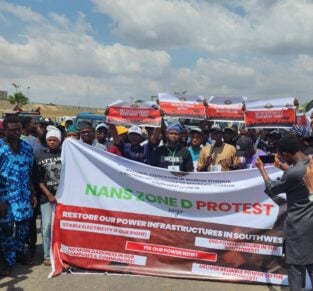
Students across tertiary institutions in South-West Nigeria, under the banner of the National Association of Nigerian Students (NANS), South-West Zone D, staged a peaceful protest on Wednesday to demand urgent intervention on poor electricity supply in the region.
The protesters, armed with placards reading “No electricity increment tariff,” “Increase power output,” and “Restore our electricity infrastructure,” converged on the November 27 Bridge, Osogbo, before marching to the Ibadan Electricity Distribution Company (IBEDC) Osun Regional Office.
Speaking to journalists, NANS South-West Coordinator Josiah Adeyemo emphasized that inadequate electricity has disrupted academic activities and caused widespread frustration among students.
“Our message to the government is clear: electricity is a basic amenity essential for stability in society and effective learning on our campuses,” Adeyemo said.
He added that if the authorities fail to address the power crisis, students are prepared to escalate protests in the coming days.
The protesters also issued a seven-day ultimatum to IBEDC, demanding the restoration of affected communities to Band A classification, warning that failure to comply could lead to further lawful collective actions, including reconsidering access for IBEDC personnel in these areas.
The demonstration, which included residents from surrounding communities, saw heavy security deployment at the IBEDC facility. Protesters chanted solidarity songs and stressed that reliable electricity is vital for academic and daily activities.
Adeyemo also linked the protest to broader social concerns, noting that ongoing security challenges, such as the recent Maiduguri bomb explosions, highlight the importance of effective governance and responsive public services.
The protest reflects growing student and community activism in Nigeria, as citizens demand accountability from power providers and government authorities to address the persistent electricity crisis affecting schools, homes, and local businesses.