
Juliet Ezeh
Africa’s industrial landscape may be on the verge of a major transformation as billionaire investor Aliko Dangote unveils plans to replicate his massive Nigerian refining project in East Africa, a move that could significantly reshape fuel production and energy security across the continent.
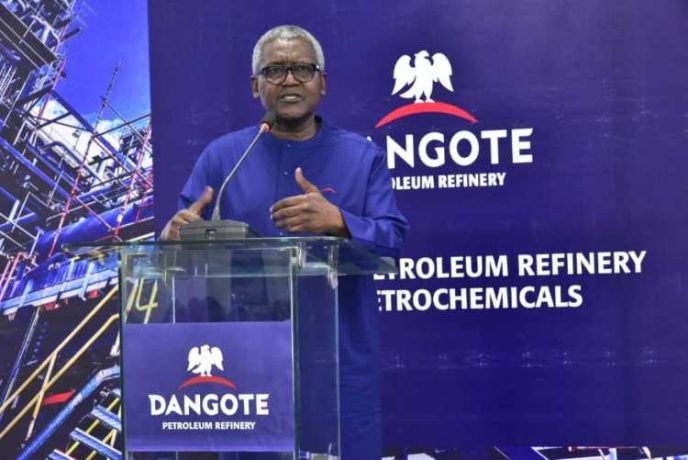
The Chairman of Dangote Group, Aliko Dangote, disclosed the plan during a high-level presidential panel at the Africa We Build Summit organised by the Africa Finance Corporation in Nairobi, where he proposed the construction of a 650,000 barrels-per-day refinery in the region.
If realised, the project would mirror the scale of the landmark facility already operating in Nigeria and would mark one of the most ambitious industrial expansions in Africa’s modern economic history.
The proposed refinery will be developed if East African governments provide the necessary regulatory and investment support. He stressed that his company is prepared to replicate the engineering, financing structure, and operational model that delivered Nigeria’s refining breakthrough.
“We can give commitment that if governments support the project, we will build the identical refinery we have in Nigeria, a 650,000 barrels-per-day facility. We have done it before, and we can do it again,” Dangote said during the summit.
The proposal comes at a time when East African nations, including Kenya, Uganda, and Tanzania, are exploring a joint refining hub in Tanga, a coastal city in Tanzania. The project is expected to refine crude sourced from across the region, including the Democratic Republic of Congo and South Sudan, as part of efforts to reduce dependence on imported fuel.
The discussions align with broader regional ambitions to strengthen energy independence and reduce vulnerability to global oil price fluctuations.
Dangote’s entry into the conversation adds significant industrial weight to the initiative, given the scale and success of his existing operations.
His flagship project, the Dangote Petroleum Refinery, located in Lagos, began operations in 2024 and is currently regarded as the largest single-train refinery in the world. Built with a capacity of 650,000 barrels per day, it was designed to meet Nigeria’s domestic fuel needs while also exporting surplus refined products across Africa and beyond.
The facility is widely seen as a turning point for Nigeria’s energy sector, reducing reliance on imported refined petroleum products and reshaping the country’s downstream market structure.
Now, Dangote says the next phase is continental expansion.
“We are already expanding the refinery in Nigeria to 1.4 million barrels per day. It will become the largest refinery in the world, accounting for about 10 per cent of U.S. refining capacity, alongside significant petrochemical production,” he said.
He added that expansion works have already begun, with piling activities underway to support the massive scale-up.
The East African proposal, if approved, would further extend Dangote’s influence in global refining, positioning him as one of the most significant private players in the downstream petroleum sector worldwide.
Beyond refining capacity, Dangote framed the project as part of a broader industrial strategy aimed at reducing Africa’s dependence on imported fuel and petrochemicals.
He warned that continued reliance on imports exposes African economies to severe price volatility and supply disruptions, citing recent spikes in global petrochemical prices as evidence.
“Look at what is happening globally. Prices can jump from $900 per tonne to nearly $3,000 in a short time. Without local production, many industries would collapse,” he said.
According to him, industries such as cement packaging, food production, and agriculture are heavily dependent on petrochemicals, making local refining capacity critical to economic stability.
Dangote also highlighted improvements in Africa’s financial ecosystem, noting that large-scale infrastructure projects are now more feasible due to stronger regional financial institutions and increased investor confidence.
“There was a time when interest rates in Nigeria were as high as 44 per cent. We had to rely on international institutions to raise funding. Today, the environment is different, and we can execute big-ticket projects locally,” he said.
In a major policy shift, he also announced plans to open up ownership of his refinery projects to African investors, with returns to be paid in U.S. dollars.
“We want Africans to invest. This is a continental asset. It will deepen the market and give Africans a stake in critical infrastructure,” he said.
East African leaders appear receptive to the idea.
Kenyan President William Ruto confirmed that discussions are ongoing between regional governments and Dangote’s team to explore a joint refinery in Tanga.
According to Ruto, the proposed facility would process crude oil from multiple countries, including Kenya, Uganda, South Sudan, and the Democratic Republic of Congo.
“We are going to have a joint refinery in Tanga to benefit all of us. We are in talks with Dangote to see how we can collaborate,” he said.
He also revealed plans for a supporting pipeline linking Kenya’s coastal city of Mombasa to Tanga to ensure a steady supply of crude oil.
Industry data shows that approximately 75 per cent of refined petroleum products consumed in East and Southern Africa are currently imported, largely from the Middle East. This heavy dependence exposes the region to global supply shocks and price fluctuations, particularly during geopolitical tensions.
Energy experts say a successful regional refinery could dramatically alter this structure, reducing import bills, stabilising fuel prices, and strengthening regional energy sovereignty.
However, analysts also caution that such mega-projects require strong political alignment, stable regulatory frameworks, and long-term financing commitments to succeed.
In Uganda, parallel efforts are already underway. The country has signed agreements for a 60,000 barrels-per-day refinery with international partners, signalling growing momentum across the region toward domestic refining capacity.
Dangote’s proposal, however, stands out due to its scale, experience, and proven execution track record.
If completed, the East African refinery would not only expand his industrial empire but also mark a significant milestone in Africa’s quest for energy independence.
For Dangote, the vision goes beyond business expansion. It reflects a broader ambition to reshape Africa’s industrial base.
He also disclosed plans to establish about 20 fertiliser blending plants across the continent by 2028, further integrating agriculture and energy supply chains.
As discussions continue, attention now shifts to how quickly governments in East Africa can translate political interest into binding agreements.
If successful, the project could redefine Africa’s energy future, turning the continent from a net importer of refined products into a global refining hub anchored by private-sector-led mega infrastructure.