
Juliet Ezeh
The planned expansion of the Dangote Refinery in Lagos to a massive 1.4 million barrels per day is shaping up to be one of the most ambitious industrial projects in Africa’s recent history, with far-reaching implications for employment, energy security, and Nigeria’s manufacturing future.
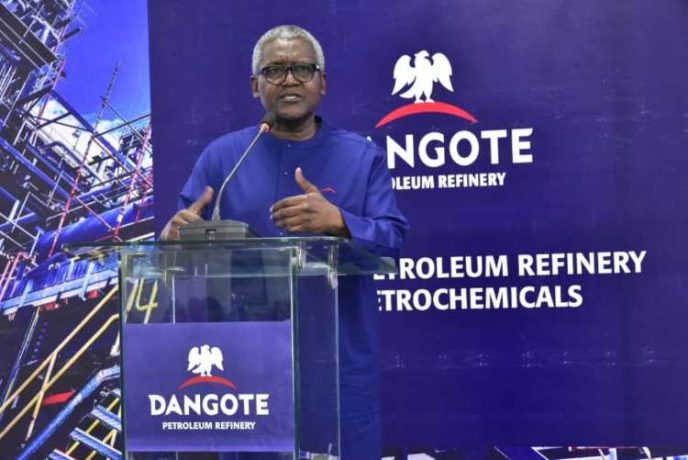
The President of the Dangote Group, Aliko Dangote, has revealed that the expansion phase alone is expected to create about 95,000 skilled jobs at its peak, a figure that immediately places the project among the largest single-site industrial employment generators in the region. The announcement came during his induction as an honorary fellow of the Nigerian Academy of Engineering in Lagos, where the business mogul used the opportunity to reflect on the scale and significance of the refinery project.
Beyond the numbers, the expansion of the Dangote Refinery represents a broader economic signal: Nigeria is attempting to shift from being a heavy importer of refined petroleum products to a self-sufficient and potentially export-driven refining hub.
At the heart of this transformation is the decision to scale the refinery from its current 650,000 barrels per day capacity to more than double that output within the next three years. This move is not just about production capacity; it is about reshaping an entire value chain that has long been dominated by imports, inefficiencies, and foreign exchange pressures.
For decades, Nigeria, despite being one of Africa’s largest crude oil producers, has relied heavily on imported refined fuel. This paradox has strained foreign reserves and contributed to recurring fuel supply vulnerabilities. The expansion of the Dangote Refinery is therefore being positioned as a corrective step that could significantly reduce the country’s dependence on imported petroleum products.
Aliko Dangote emphasized that the project is rooted in confidence in local capacity and engineering expertise. According to him, the scale of construction and operation demonstrates that African-led infrastructure projects can meet global standards without relying entirely on external systems. The emphasis on skilled labour also suggests a deliberate effort to build technical capacity within the country’s engineering and industrial workforce.
The projection of 95,000 skilled workers during peak construction is particularly significant in the Nigerian context, where youth unemployment and underemployment remain persistent challenges. While not all of these jobs will be permanent, the ripple effect of such large-scale employment could extend into subcontracting, logistics, manufacturing supply chains, and service industries that support industrial construction.
Industry analysts argue that projects of this magnitude often generate secondary employment that far exceeds direct job numbers. From equipment suppliers to transport operators and catering services, large industrial sites typically create entire ecosystems of economic activity around them. In this case, the refinery’s expansion could stimulate thousands more indirect jobs across Lagos State and beyond.
The engineering dimension of the project also carries strategic importance. Speaking at the induction ceremony, the President of the Nigerian Academy of Engineering, Prof. Rahamon Bello, noted that Dangote’s impact goes beyond physical infrastructure. He highlighted that the project has already begun inspiring a new generation of engineers and entrepreneurs who now see large-scale industrial development as achievable within Africa.
This sentiment reflects a broader shift in perception. For many years, large refinery projects in Africa were either stalled, abandoned, or dependent on foreign operators. The Dangote Refinery, however, has become a reference point for indigenous capacity in executing complex energy infrastructure projects at scale.
Another key implication of the expansion lies in foreign exchange savings. Nigeria spends billions annually importing refined petroleum products. By increasing domestic refining capacity, the country could significantly reduce this outflow, stabilizing the naira over time and easing pressure on external reserves. While exact savings will depend on operational efficiency and crude supply arrangements, the potential macroeconomic benefit is widely acknowledged.
Energy security is another central pillar of the expansion narrative. A refinery of this scale, operating efficiently, could help stabilize domestic fuel supply, reduce scarcity cycles, and potentially create export opportunities for refined products within West Africa. This would not only strengthen Nigeria’s position as a regional energy hub but also enhance its geopolitical influence in the downstream oil sector.
However, analysts also caution that the success of the expansion will depend on several critical factors, including regulatory stability, crude supply guarantees, logistics infrastructure, and the broader macroeconomic environment. Large-scale industrial projects in Nigeria have historically faced challenges ranging from policy inconsistencies to infrastructure bottlenecks, particularly in power, transportation, and port efficiency.
Still, the momentum surrounding the Dangote Refinery suggests a strong investor confidence signal. The project has already become a reference point for discussions about private sector-led industrialization in Africa. Its expansion reinforces the idea that large-scale infrastructure does not always require full state ownership to succeed, but can be driven by strategic private capital aligned with national development goals.
The timing of the expansion also aligns with growing global conversations around energy transition and refining capacity shifts. While many economies are gradually moving toward cleaner energy sources, demand for refined petroleum products remains strong in developing regions. Nigeria’s strategy, through this expansion, appears focused on maximizing current hydrocarbon value while also strengthening industrial foundations for future diversification.
For local communities and the broader labour market, the immediate impact will likely be most visible during the construction phase. Skilled engineers, welders, technicians, machine operators, and project managers are expected to be in high demand. Training institutions and technical schools may also experience increased pressure to supply qualified personnel, potentially accelerating reforms in vocational education.
In the long term, the refinery’s expanded capacity could also reshape Nigeria’s downstream oil market structure. Increased local supply may influence pricing dynamics, distribution networks, and competition among fuel marketers. If managed effectively, this could lead to more stable fuel availability and potentially improved pricing efficiency for consumers.
Ultimately, the expansion of the Dangote Refinery is more than an industrial upgrade. It is a test case for Nigeria’s broader economic ambition to move from raw material export dependence to value-added production. It also represents a rare convergence of private capital, engineering capacity, and national economic interest on a scale rarely seen in the region.
As construction progresses toward its multi-year timeline, attention will remain focused not only on the engineering milestones but also on whether the promised economic transformation jobs, savings, and industrial growth materializes at the scale being projected.