
By Juliet Ezeh
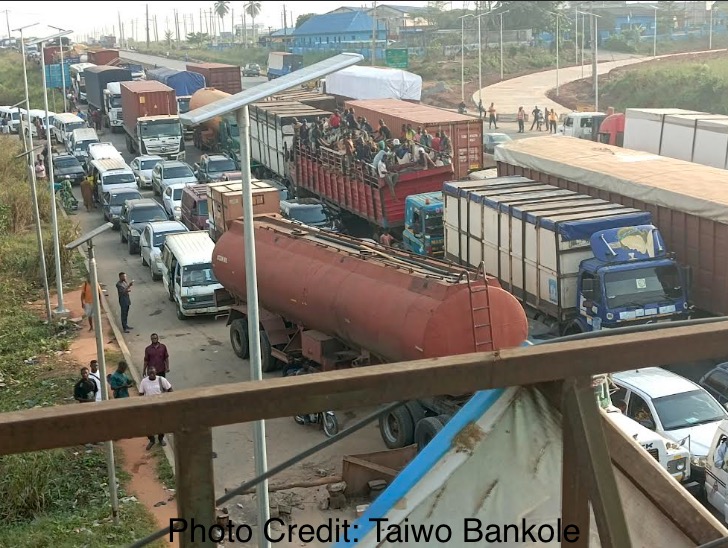
Major transport corridors linking Lagos to other parts of the South-West and South-South were thrown into chaos on Tuesday morning as severe traffic congestion crippled movement along the Lagos-Ibadan Expressway and the Sagamu-Benin highway.
What began as a routine commute quickly deteriorated into hours of frustration for motorists and commercial drivers after a partial road closure at the Sagamu Interchange significantly narrowed traffic flow. The affected stretch, currently undergoing reconstruction, became a choke point that triggered a ripple effect of congestion stretching several kilometres in multiple directions.
Eyewitness accounts indicate that vehicles were trapped from the interchange axis toward Ogere Remo, with the backlog reportedly extending near the Animal Care corridor. On the Sagamu-Ijebu Ode-Benin route, the buildup nearly reached the Sagamu Junction, further compounding the disruption.
The gridlock forced some commuters to abandon their vehicles and continue on foot, while others scrambled to identify alternative routes to avoid missing critical appointments and business engagements.
One motorist heading toward Ibadan said he had no choice but to reroute through Siun after discovering that access through the interchange had effectively stalled. According to him, the situation underscored the urgent need for improved traffic management strategies during infrastructure upgrades.
The recurring congestion at the Sagamu Interchange highlights a broader infrastructure dilemma. While reconstruction projects are essential for long-term economic growth and safer road networks, inadequate diversion planning and limited real-time traffic coordination often transfer the burden directly to commuters.
The Lagos-Ibadan and Sagamu-Benin highways serve as vital arteries for interstate commerce, passenger transport and haulage operations. Any prolonged obstruction along these routes disrupts supply chains, increases fuel consumption and inflates transport costs, with ripple effects on goods and services across the region.
For logistics operators and small business owners, time lost in traffic translates directly into financial loss. For daily commuters, it means diminished productivity and heightened stress.
Infrastructure experts have repeatedly emphasised the importance of phased construction scheduling, clear signage, advance public advisories and active traffic control measures to minimise disruptions during road rehabilitation projects.
Tuesday’s congestion episode raises renewed questions about whether sufficient mitigation measures were deployed before narrowing one of the country’s busiest interchanges.
As reconstruction continues, road users are calling for more proactive communication from project handlers and traffic authorities to prevent future paralysis of these critical highways.
While improved road infrastructure remains a national priority, the execution process must balance development with mobility. Without strategic coordination, progress on paper can translate into gridlock on the ground.

Juliet Ezeh is the founder and chief reporter at Westbridge Reporters with over 7 years of experience in journalism. She covers crime, industry, policy, and social developments, delivering timely and accurate reporting.