
By Juliet Ezeh
Nigeria has taken a decisive step toward redefining its economic direction as President Bola Ahmed Tinubu unveiled the Nigeria Industrial Policy (NIP) 2025 a strategy aimed at breaking the country’s long-standing dependence on imports and repositioning it as a production-driven economy.
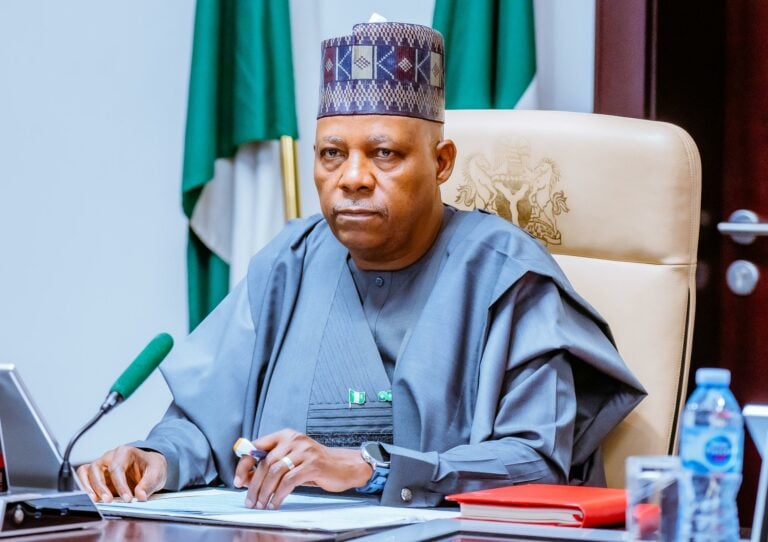
Launched on behalf of the President by Vice President Kashim Shettima, the new policy framework signals what the administration describes as a deliberate industrial reset one designed to convert Nigeria’s economic potential into measurable industrial output.
Rather than introducing another broad policy statement, government officials say the NIP 2025 focuses on execution, accountability and sector-specific results. The framework integrates energy, infrastructure, finance, skills development and trade policy into a coordinated system intended to unlock manufacturing growth.
From Consumption to Production
For decades, Nigeria has struggled with low industrial output despite its large domestic market and abundant natural resources. Officials argue that the new policy confronts that imbalance head-on by prioritising domestic value addition and reducing reliance on imported finished goods.
Under the blueprint, industries where Nigeria holds comparative advantage including agro-processing, petrochemicals, pharmaceuticals, textiles, light manufacturing, metals and technology-enabled sectors will receive targeted policy support.
The administration emphasised that industrialisation will not happen by chance but through coordinated government action backed by measurable performance benchmarks and public-private collaboration.
Learning from the Shea Example
Minister of State for Industry, Trade and Investment, John Owan Enoh, described the launch as a turning point, stressing that the policy draws lessons from previous fragmented industrial efforts.
He cited the recent transformation in the shea value chain as evidence that deliberate policy interventions can yield results. According to him, restricting raw shea nut exports encouraged domestic processing, expanded local crushing capacity and increased export earnings from processed products within a year.
Officials say similar value-chain strategies will now be extended across priority sectors to deepen manufacturing and expand local supply chains.
Tackling Structural Constraints
The policy directly addresses long-standing barriers facing Nigerian manufacturers, including unstable power supply, infrastructure gaps, limited financing access, regulatory uncertainty and skills shortages.
Government representatives acknowledged that macroeconomic stability and policy consistency will be critical to restoring investor confidence. The framework therefore assigns clear institutional responsibilities and performance indicators to improve accountability.
Industry stakeholders present at the launch stressed that government clarity must be matched by private sector investment, innovation and job creation.
Positioning Nigeria for AfCFTA Opportunities
With the African Continental Free Trade Area (AfCFTA) opening new regional trade corridors, the policy seeks to position Nigeria as a competitive production hub serving both domestic and West African markets.
Officials say integrating logistics, trade facilitation and industrial clusters into one coordinated strategy will enable Nigeria to plug into regional supply chains more effectively.
The government insists implementation begins immediately, underscoring its commitment to moving beyond policy announcements toward industrial results.
If successfully executed, the Nigeria Industrial Policy 2025 could mark a structural shift in Africa’s largest economy from an import-reliant market to a manufacturing base capable of competing regionally and globally.

Juliet Ezeh is the founder and chief reporter at Westbridge Reporters with over 7 years of experience in journalism. She covers crime, industry, policy, and social developments, delivering timely and accurate reporting.