
By Juliet Ezeh
Nigeria’s anti-narcotics campaign took a dramatic turn last week as operatives of the National Drug Law Enforcement Agency intensified a sweeping crackdown that exposed an alleged drug distribution network stretching from upscale estates in Lagos to forests, highways, airports and seaports across the country.
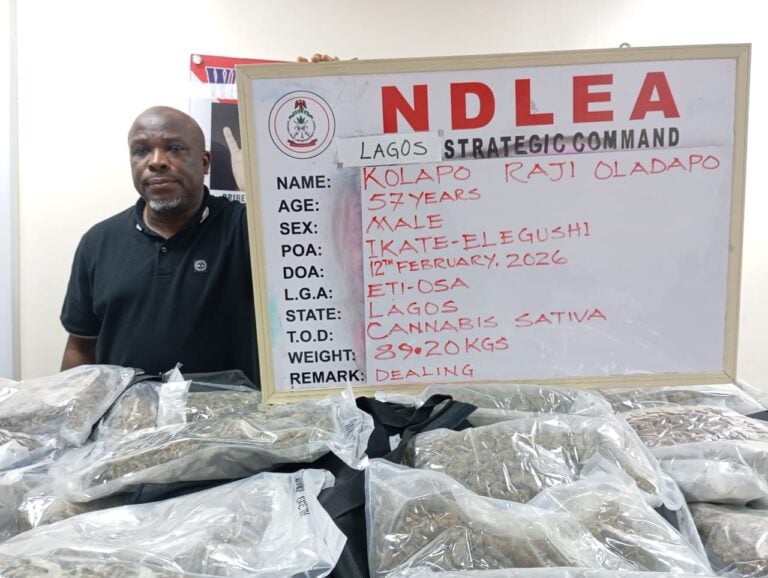
At the centre of the latest operation is a 57-year-old Lagos real estate developer and chief executive of Trans Fortress Global Resources, Kolapo Raji, who was arrested at his Ikate, Lekki residence shortly after returning from the United Kingdom. According to the agency, he had been under surveillance since 2025 before officers moved in.
A search of his apartment reportedly led to the recovery of 89.20 kilograms of Canadian Loud, a potent strain of cannabis, along with a 2024 Toyota Hilux vehicle. Investigators allege that the suspect initially financed drug consignments for overseas associates before establishing what authorities described as an independent distribution channel after earning substantial profits.
The arrest underscores a growing trend identified by anti-narcotics authorities: the use of legitimate-looking enterprises, including property development and logistics outfits, as operational fronts for drug storage and distribution. Enforcement officials say traffickers increasingly blend into urban commercial environments to evade detection, making intelligence-led surveillance crucial.
Beyond Lagos, the agency’s coordinated operations reveal the scale and complexity of Nigeria’s drug trafficking challenge.
At the departure hall of the Mallam Aminu Kano International Airport, officers intercepted a 41-year-old Ivorian national, Michael Gohouri, during clearance for an Ethiopian Airlines flight to Milan via Addis Ababa. A body scan reportedly confirmed ingestion of illicit substances, and authorities said he later excreted 82 wraps of cocaine weighing 1.49 kilograms. He is alleged to have been promised €5,000 upon successful delivery in Italy.
Security analysts say such airport interceptions highlight Nigeria’s dual role as both a transit corridor and destination market for narcotics. West Africa’s geographic positioning has historically made it vulnerable to transnational trafficking routes linking Latin America, Europe and Asia.
In separate operations across states, the NDLEA reported significant seizures. In Kano and Lagos corridors, suspects were apprehended with tens of kilograms of skunk, another cannabis derivative. At the Port Harcourt Ports Complex in Onne, Rivers State, officers conducting a joint inspection with Customs and other agencies uncovered 170,900 bottles of codeine-based syrup concealed in a container — a seizure that reflects continued demand for controlled prescription substances.
Along the Okene–Lokoja highway in Kogi State, operatives reportedly found 7,300 tramadol pills hidden inside sound systems in a commuter bus, illustrating traffickers’ evolving concealment methods. Follow-up arrests were later made in Abuja.
Forest enclaves in Ondo and Edo states were not spared. In Ondo, suspects were arrested with nearly 400 kilograms of skunk during raids, while in Edo, over 1,200 kilograms of cannabis were destroyed on farms in Owan West Local Government Area. Bauchi State recorded one of the largest seizures, with more than 1,000 kilograms of skunk recovered in Azare town and surrounding areas.
Altogether, the seizures from the various operations amount to well over one tonne of illicit substances, reinforcing the agency’s assertion that trafficking networks operate on an industrial scale.
Public health experts warn that beyond criminality, the proliferation of narcotics poses serious social consequences. Rising substance abuse among young people, addiction-related mental health issues, and the burden on rehabilitation centres are becoming growing concerns nationwide. The abuse of opioids such as tramadol and codeine-based syrups has, in recent years, triggered regulatory reforms and stricter prescription controls.
Security observers argue that sustained crackdowns must be complemented by preventive strategies, including youth engagement programmes, improved border surveillance technology, financial tracking of illicit proceeds, and international cooperation.
The NDLEA’s latest operations signal a more aggressive posture against syndicates, particularly those attempting to disguise trafficking under legitimate business structures. While arrests and seizures disrupt supply chains, analysts maintain that dismantling the financial backbone of such networks will be critical to achieving long-term impact.
As investigations continue, the unfolding cases are expected to test Nigeria’s judicial processes and its broader capacity to confront an illicit trade that spans continents, industries and social classes.

Juliet Ezeh is the founder and chief reporter at Westbridge Reporters with over 7 years of experience in journalism. She covers crime, industry, policy, and social developments, delivering timely and accurate reporting.