
Juliet Ezeh
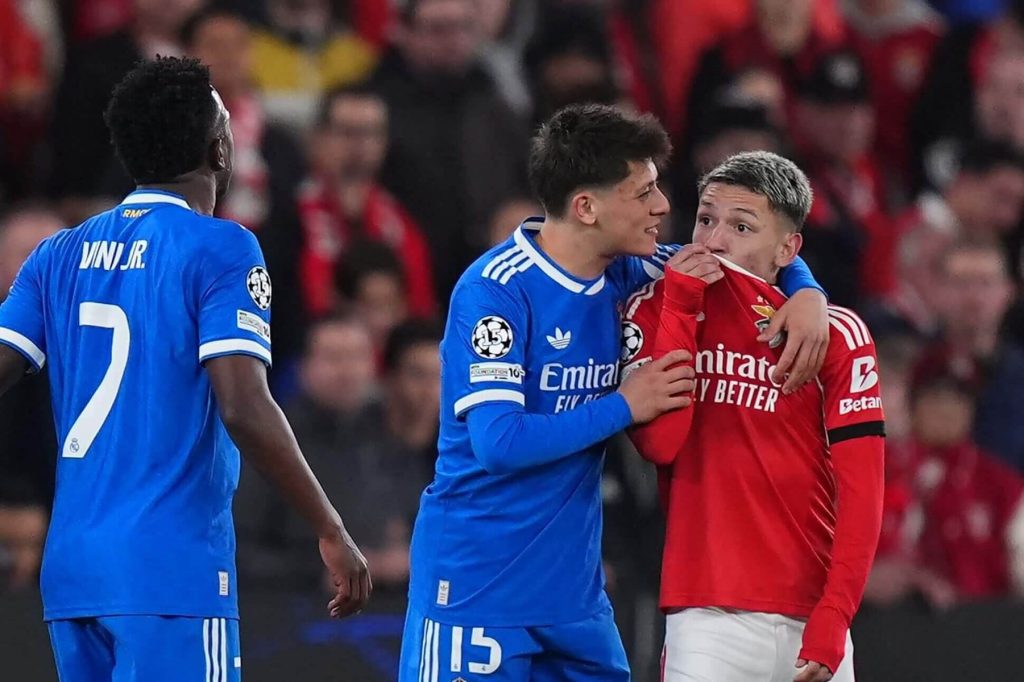
European football governing body, UEFA, has imposed a six-match suspension on Benfica forward Gianluca Prestianni following allegations of abusive conduct during a heated UEFA Champions League play-off clash against Real Madrid.
The sanction, confirmed by Portuguese giants Benfica in an official statement on Friday, stems from incidents that occurred during the first-leg encounter in Lisbon, which was marred by controversy both on and off the pitch.
According to the club, UEFA’s disciplinary body found Prestianni guilty of using inappropriate and offensive language during the match, resulting in a six-game ban from European competitions. While Benfica’s statement referenced “homophobic language” as the basis for the punishment, the incident had earlier drawn wider attention after Real Madrid star Vinícius Júnior accused the young winger of directing racist remarks at him during the game.
The allegations quickly escalated into one of the most talked-about moments of the Champions League play-offs, highlighting ongoing concerns about discriminatory behaviour in football despite repeated campaigns to stamp it out.
The first leg, played in Lisbon, had already been an intense contest between two high-profile clubs, but tensions boiled over following an exchange between Prestianni and Vinícius Júnior. The Brazilian international later made it known that he felt targeted by offensive comments, prompting scrutiny from match officials and UEFA.
UEFA responded by opening an investigation into the incident, reviewing reports from referees, disciplinary officials, and other available evidence. The governing body subsequently took immediate action by suspending Prestianni for the return leg at the Santiago Bernabéu, signaling the seriousness of the allegations even before the final verdict was delivered.
With the latest ruling, UEFA has now extended the punishment to a total of six matches, reinforcing its zero-tolerance stance on discriminatory conduct in football.
The case adds to a growing list of incidents involving Vinícius Júnior, who has repeatedly been at the center of conversations around racism in football. The Real Madrid winger has become a vocal advocate against abuse, often calling for stricter sanctions and stronger enforcement from football authorities.
For Benfica, the development represents both a disciplinary setback and a reputational concern, as the club now faces the task of managing the fallout while supporting its player through the consequences of UEFA’s decision.
Prestianni, regarded as one of Benfica’s emerging talents, will now miss a significant portion of European fixtures, potentially impacting the team’s attacking options in upcoming competitions. The suspension could also have broader implications for his development and standing within the squad.
Football observers note that UEFA’s decision reflects an increasing willingness to impose tougher penalties in cases involving discriminatory language, whether racial, homophobic, or otherwise offensive. The governing body has in recent years intensified efforts to combat abuse through campaigns, stricter regulations, and disciplinary measures.
However, critics argue that more still needs to be done to address the root causes of such behaviour, including education at grassroots level and stronger accountability mechanisms across leagues and clubs.
The incident has once again brought the issue of player conduct under the spotlight, raising questions about discipline, respect, and the responsibilities of professional athletes on the global stage.
As European competitions continue, UEFA is expected to maintain close monitoring of on-field behaviour, with officials reiterating that any form of discrimination will attract severe consequences.
For Vinícius Júnior, the episode serves as another reminder of the challenges faced by players subjected to abuse, while also reinforcing his role as a central figure in the ongoing fight against discrimination in football.
With the six-match ban now confirmed, attention will shift to how Benfica adjusts tactically in Prestianni’s absence and how the player responds after serving his suspension.
Ultimately, the case underscores a broader message from UEFA: that football must remain a space of respect, inclusivity, and fair competition, where any form of abuse has no place.