
Juliet Ezeh
The Catholic Bishop of Sokoto Diocese, Most Rev. Dr. Matthew Hassan Kukah, has urged Nigerians to stop referring to him as a Hausa man, insisting that his identity reflects the broader Nigerian diversity rather than a single ethnic label.
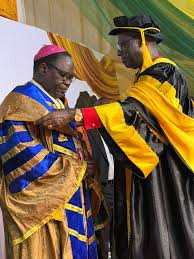
Kukah made this clarification on Saturday during the 16th convocation ceremony of Chukwuemeka Odumegwu Ojukwu University, held at the institution’s auditorium in Igbariam, Anambra State, where he was formally installed as Chancellor.
Speaking before a gathering of dignitaries, academics, graduates, and their families, Kukah expressed concern over what he described as a persistent misrepresentation of his ethnic identity, noting that while he hails from Northern Nigeria, he is not Hausa by origin.
“I am a typical Nigerian from Anchuna, Ikulu Chiefdom in Zangon Kataf Local Government Area of Kaduna State, but not a Hausa man by origin. Nigerians should stop addressing me as a Hausa person,” he said.
His remarks struck a broader chord beyond personal identity, touching on the complex issue of ethnicity and national unity in Nigeria, a country often shaped by strong ethnic affiliations.
Kukah, who has long been known for his outspoken views on governance, national cohesion, and social justice, used the platform to subtly reinforce the importance of embracing a unified Nigerian identity over ethnic stereotypes.
The cleric’s comments come at a time when conversations around identity, regionalism, and inclusivity remain central to Nigeria’s socio-political landscape. By distancing himself from ethnic labeling, Kukah underscored the need for Nigerians to move beyond assumptions based on geography, language, or religion.
Beyond addressing identity, Kukah also took the opportunity to outline his vision as the newly appointed Chancellor of the university. He pledged to work closely with the institution’s leadership to not only achieve its goals but exceed them.
“As the new Chancellor of this institution, we will not only strive to achieve the university’s goals, but surpass them,” he stated.
He also commended the Anambra State Government for its sustained investment in education, noting that the state continues to stand out in academic performance when compared to others across the federation.
“Statistically, Anambra is performing well in education among the 36 states,” Kukah added, praising the government’s commitment to human capital development.
Kukah expressed gratitude to the Anambra State Governor, Chukwuma Soludo, for appointing him as Chancellor, describing the gesture as both an honour and a call to service.
Governor Soludo, who officially installed Kukah during the ceremony, said the appointment was based on the bishop’s wealth of experience, moral authority, and leadership track record.
“It was a great honour to be present at the 16th Convocation Ceremony of Chukwuemeka Odumegwu Ojukwu University as a visitor to this great institution,” Soludo said.
“The ceremony was a celebration of excellence, hard work, and the power of quality education. It was also a reminder of the critical role universities play in training skilled manpower, shaping character, advancing knowledge, and preparing young people to contribute meaningfully to society.”
Soludo expressed confidence that Kukah’s leadership would elevate the university’s reputation and strengthen its vision.
“I am confident that his wisdom, experience, and moral leadership will further strengthen the vision and standing of the university,” he added.
The governor also used the occasion to reward academic excellence among the graduating students. He announced a ₦4 million cash prize for the overall best graduating student, Somtochukwu Augustus Ume of the Economics Department, who achieved a remarkable cumulative grade point average of 4.85 out of 5.0.
In addition, Soludo offered scholarships to 37 first-class graduates from the institution, enabling them to pursue postgraduate studies up to the highest level at any public university of their choice within Nigeria.
The initiative, according to the governor, is aimed at encouraging academic excellence and ensuring that outstanding students are supported in reaching their full potential.
“Our institutions of higher learning must go beyond awarding certificates; they must raise innovative, solution-driven, and globally competitive graduates who can respond to the challenges of our time,” Soludo said.
He further charged universities across the country to prioritise innovation, critical thinking, and practical problem-solving skills over rote learning.
“To the graduands, I urge you to seize the moment and emerge as beacons of hope, disruptive thinkers, and agents of change in society. The future belongs to those who are prepared to lead with courage, creativity, and purpose,” he added.
Earlier in his address, Kukah also urged the graduating students to uphold strong moral values and be good ambassadors of their families, the university, and the nation.
He emphasised the importance of character in addition to academic achievement, reminding the graduands that integrity, discipline, and resilience are essential for success in life.
“You must be of good character to your parents, this university community, Anambra State, the South-East region, and Nigeria as a whole,” Kukah advised.
The convocation ceremony brought together stakeholders from across the education sector and beyond, highlighting the critical role universities play in national development.
For many observers, Kukah’s remarks on identity stood out as one of the defining moments of the event, sparking conversations about how Nigerians perceive one another in a diverse society.
As Nigeria continues to grapple with issues of unity and inclusion, his message serves as a reminder that national identity should transcend ethnic boundaries, fostering a sense of shared belonging among citizens.
The event ultimately celebrated not only academic achievement but also the enduring values of leadership, unity, and the transformative power of education in shaping the future of the nation.