
Juliet Ezeh
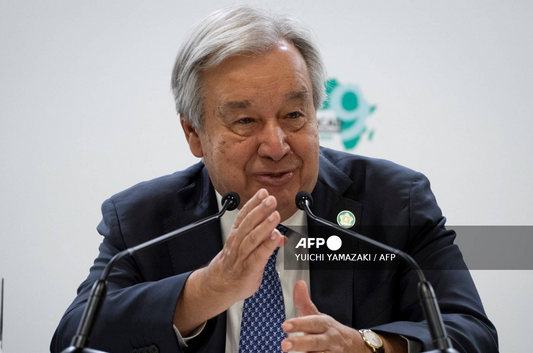
United Nations Secretary-General Antonio Guterres has strongly condemned the surge in coordinated attacks across Mali, warning that the worsening security situation in the Sahel nation requires urgent international intervention and stronger regional cooperation.
In a statement issued on Saturday through his spokesperson, Stephane Dujarric, the UN chief expressed deep concern over reports of multiple violent assaults carried out in different parts of the country, including areas close to the capital, Bamako.
Guterres said the latest wave of attacks highlights the growing threat posed by extremist groups and armed factions operating in Mali, stressing that the safety of civilians must remain a top priority.
“The Secretary-General is deeply concerned by reports of attacks in several locations across Mali,” the statement read, adding that he “strongly condemns these acts of violence” and stands in solidarity with the Malian people during a period of heightened insecurity.
The renewed violence comes after an Al-Qaeda-linked jihadist group reportedly joined forces with Tuareg rebels to execute one of the most sophisticated and coordinated offensives seen in the country in recent years. The attacks, launched at dawn, targeted multiple locations simultaneously, catching security forces off guard and underscoring the evolving tactics of armed groups in the region.
According to reports, the assailants struck areas around Bamako as well as other strategic regions, while Tuareg rebel fighters claimed control of the northern city of Kidal an area that has long been a flashpoint in Mali’s complex conflict landscape.
Security analysts say the apparent collaboration between jihadist elements and separatist rebels marks a dangerous shift, potentially increasing the scale and impact of future attacks. The alliance, if sustained, could further destabilise an already fragile nation struggling with years of insurgency and political upheaval.
Guterres warned that the crisis in Mali is no longer a domestic issue alone but part of a broader regional challenge affecting the entire Sahel. He called for enhanced security coordination among countries in the region, alongside increased international support to tackle terrorism and address the humanitarian consequences of prolonged conflict.
“The Secretary-General calls for coordinated international support to address the evolving threat of violent extremism and terrorism in the Sahel and to meet urgent humanitarian needs,” Dujarric said.
He also emphasised the importance of protecting civilian populations and critical infrastructure, noting that continued attacks on communities, public facilities, and essential services risk deepening the humanitarian crisis in Mali.
Since 2012, Mali has been locked in a protracted conflict involving jihadist groups, ethnic militias, and separatist movements. The violence has claimed thousands of lives and forced tens of thousands of people to flee their homes, creating a significant displacement crisis both within the country and across its borders.
Despite multiple international interventions and peacekeeping efforts, the security situation has remained volatile, with armed groups expanding their reach into previously stable areas.
The situation has been further complicated by political instability. Mali has experienced two military coups in recent years, in 2020 and 2021, which brought a junta government to power. The military leadership justified its takeover by citing the need to more effectively combat insurgent groups and restore national security.
However, years after the coups, attacks have not only persisted but, in some cases, intensified, raising questions about the effectiveness of current strategies and the capacity of the state to contain the threat.
Observers note that the withdrawal or reduction of some international forces in the region has also contributed to security gaps, allowing armed groups to regroup and launch more ambitious operations.
The reported seizure of Kidal by Tuareg rebels is particularly significant. The northern city has historically been a stronghold for separatist movements and has played a central role in previous peace agreements. Its fall to rebel forces could signal a breakdown in existing arrangements and further complicate efforts to stabilise the region.
Humanitarian agencies have also raised alarm over the impact of the renewed violence on vulnerable populations. With access to food, healthcare, and basic services already limited in many parts of Mali, continued insecurity threatens to worsen living conditions for millions of people.
Guterres urged all parties involved in the conflict to exercise restraint and adhere to international humanitarian law, calling for immediate efforts to de-escalate tensions and prioritise dialogue where possible.
As Mali grapples with this latest escalation, the international community faces increasing pressure to reassess its approach to the Sahel crisis. Analysts argue that without a combination of military, political, and socio-economic solutions, the cycle of violence is likely to persist.
For now, the people of Mali remain caught in the crossfire of a complex and evolving conflict, with hopes that renewed global attention and coordinated action can help restore stability and prevent further loss of life.