
Juliet Ezeh
President Bola Ahmed Tinubu has intensified early political preparations ahead of the 2027 general elections with a fresh directive aimed at strengthening the All Progressives Congress (APC) structure in Abia State, South East Nigeria.
The President has reportedly mandated former Abia State Governor and serving Senator for Abia North, Orji Uzor Kalu, to take charge of coordinating APC activities in the state as part of a broader strategy to reposition the party in a region where it has historically struggled to gain strong electoral footing.
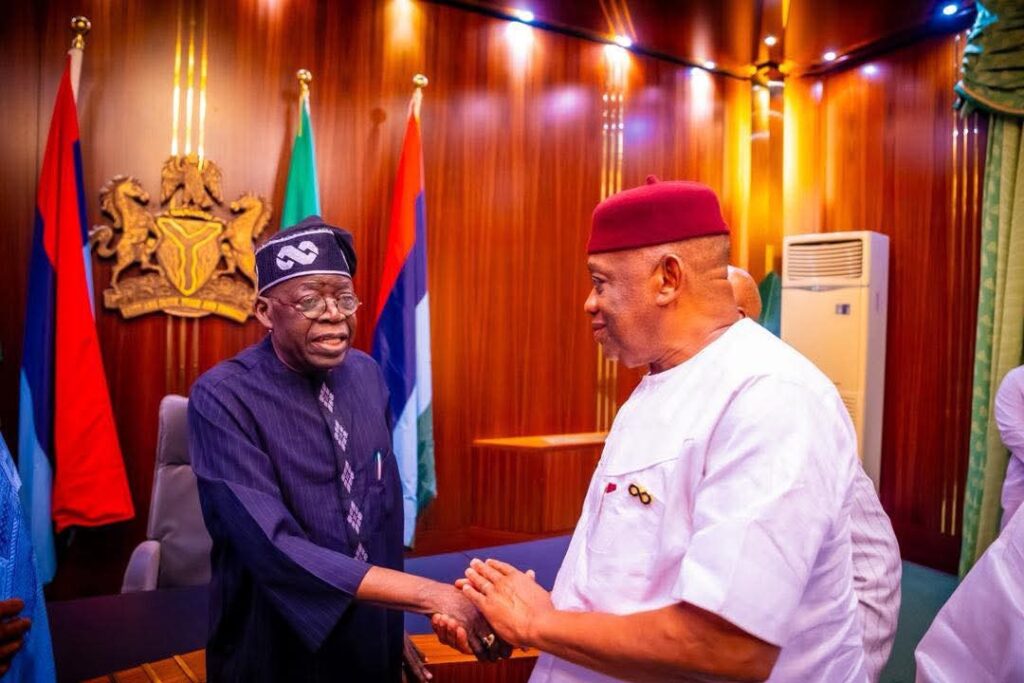
Kalu, who currently chairs the Senate Committee on the South East Development Commission, confirmed the development following a recent meeting with President Tinubu at the Presidential Villa in Abuja. According to him, the assignment reflects the President’s confidence in his political experience and influence within Abia’s political landscape.
In a post shared on his official Facebook page, Kalu expressed appreciation to the President for the responsibility given to him, describing it as a directive aimed at strengthening unity within the party ahead of the next general elections.
He stated that the focus of his coordination role would be to foster internal cohesion among party members in Abia State, reconcile existing factions, and ensure the emergence of candidates who are widely acceptable and capable of delivering electoral victory for the APC.
“As the most senior former governor in the state, I am committed to working closely with all stakeholders, in line with the President’s directive, to ensure that the APC in Abia produces candidates who are widely acceptable, united in purpose, and well-positioned to secure victory in the state for the President’s re-election, while advancing the best interests of Abia State and Nigeria at large,” Kalu said.
Political observers say the appointment is part of a calculated move by the Tinubu administration to rebuild APC structures in the South East, a region where the party has consistently faced strong opposition from rival political blocs.
The development is also seen as an attempt to consolidate the party’s grassroots network in Abia State, where internal divisions and past electoral setbacks have weakened its influence over the years.
President Tinubu, who leads the APC as national leader, is reportedly focused on strengthening party unity across key states while ensuring that influential political figures are strategically positioned to drive mobilization and electoral success ahead of 2027.
In a related political development, indications have emerged that the President may be considering a continuity strategy for some lawmakers at the National Assembly, including the possibility of automatic return tickets for select senators considered loyal and effective in legislative duties.
Kebbi State Governor, Nasir Idris, popularly known as Kauran Gwandu, hinted at the development during a political engagement with stakeholders in the state, suggesting that discussions are ongoing regarding the political future of certain key lawmakers.
Among the lawmakers reportedly being considered for continuity are several influential senators including figures such as Orji Uzor Kalu, Adamu Aliero, Abdulaziz Yari, Opeyemi Bamidele, Yahaya Abdullahi, Idiat Oluranti Adebule, Danjuma Goje, and Adetokunbo Abiru, among others.
Governor Idris noted that these lawmakers have played significant roles in stabilising the National Assembly, supporting executive policies, and ensuring smooth legislative processes under the current administration.
He further explained that their contributions have helped strengthen collaboration between the executive and legislative arms of government, which he described as essential for national stability and policy implementation.
Although there has been no official confirmation from the Presidency or the national leadership of the APC regarding automatic Senate tickets, the development has already generated widespread debate within political circles across the country.
Analysts believe the move, if confirmed, would be part of a broader strategy by the Tinubu administration to retain experienced lawmakers, maintain institutional stability, and prevent internal disruptions within the ruling party ahead of the 2027 elections.
Political commentators also argue that positioning influential figures like Kalu in strategic coordination roles, alongside potential continuity plans in the Senate, reflects a long-term consolidation plan aimed at strengthening APC’s dominance at both state and federal levels.
In the South East, where APC has traditionally faced electoral challenges, the appointment of Kalu is expected to serve as a bridge between the party leadership and grassroots political actors, helping to unify factions and improve voter mobilization.
As the 2027 elections gradually approach, the unfolding political arrangements signal an early and deliberate effort by the ruling party to secure its base, maintain legislative stability, and expand its influence in regions where opposition strength has remained dominant.
For now, stakeholders continue to watch closely how these developments will shape the internal dynamics of the APC and influence Nigeria’s broader political landscape in the coming years.