
Juliet Ezeh
The Deputy Governor, Corporate Services at the Central Bank of Nigeria (CBN), Emem Usoro, has declared that sweeping reforms introduced by the apex bank played a critical role in shielding Nigeria’s economy from collapse, even as she highlighted ongoing efforts to stabilise and reposition the country’s financial system for long-term growth and resilience.
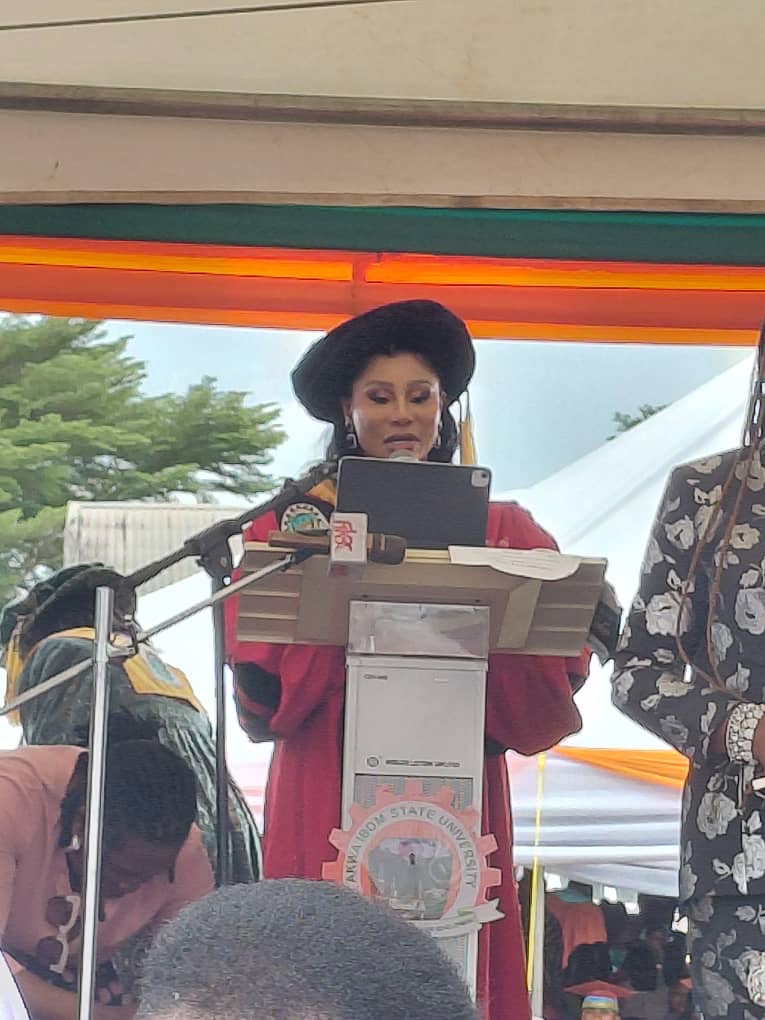
Usoro made this assertion on Saturday while delivering her acceptance speech at the conferment of an honorary Doctor of Business Administration (honoris causa) during the combined 9th, 10th, 11th and 12th convocation ceremonies of Akwa Ibom State University, held in Ikot Akpaden, Mkpat Enin Local Government Area.
Addressing a gathering of graduates, dignitaries, and academics, the CBN deputy governor emphasised that deliberate policy coordination, institutional reforms, and strategic interventions have helped Nigeria navigate turbulent economic conditions in recent years, including inflationary pressures, foreign exchange instability, and global economic shocks.
“We have developed systems and implemented policies that brought the country back from economic disaster and are positioning the economy to better serve all segments of society,” she said.
She further explained that the bank’s strategy of aligning monetary policies with the Federal Government’s fiscal reforms has yielded measurable outcomes, including improved exchange rate stability, stronger macroeconomic fundamentals, and a more inclusive economic framework that supports businesses, entrepreneurs, and households across the country.
According to Usoro, the collaboration between fiscal and monetary authorities is now driving sustainable growth, improving investor confidence, and expanding opportunities across key sectors of the economy, particularly in agriculture, manufacturing, financial services, and small and medium-scale enterprises.
“In great synergy with the Federal Government, we have aligned our monetary policies with its fiscal reforms. This has already achieved exchange rate and macroeconomic stability, boosted economic growth, and is fostering an inclusive economy for sustainable development,” she added.
The convocation ceremony also saw several prominent Nigerians honoured for their contributions to national development. Among them were the Emir of Kano, Aminu Ado Bayero; Managing Director of Hensek Engineering Limited, Engr. Uwem Okoko; Engr. Oliver Ebong; Pastor Inyang Udo Tobby; and Engr. Elvis Effiong Osung.
Beyond economic reforms, Usoro used the platform to underscore the critical role of human capital development in national progress, urging graduating students to harness their knowledge, skills, and creativity to drive innovation, entrepreneurship, and economic transformation.
She pointed to countries such as Singapore, Japan, and South Korea as examples of nations that achieved remarkable economic transformation not through natural resources, but by investing heavily in education, innovation, technology, and the productivity of their citizens.
“Countries without vast mineral resources have attained prosperity by leveraging the brilliance of their young people. Let your knowledge become a powerful tool for positive impact,” she advised.
Usoro described the graduating students as the “future and promise” of Nigeria, stressing that the country’s economic trajectory depends heavily on the contributions of educated, skilled, and innovative youths entering the workforce at a time of global economic competition and rapid technological advancement.
She also announced that the Central Bank of Nigeria would provide financial support to Akwa Ibom State University to enhance its academic and research capacity, reinforcing the bank’s commitment to education-driven development, innovation, and knowledge-based growth.
“As an institution, we will be supporting the university with a token for its academic and research work for greater impact in Nigeria,” she said.
In a message directed particularly at female graduands, Usoro encouraged them not to be limited by societal and cultural barriers, emphasising that success is built on preparation, resilience, focus, courage, and determination.
She urged all graduates to remain intellectually curious, continuously seek knowledge, embrace innovation, and stay adaptable in a rapidly evolving global economy where skills, creativity, and ideas are becoming the most valuable assets.
A total of 6,779 undergraduate students and 746 postgraduate students were awarded degrees during the convocation ceremonies, marking a significant milestone for the institution and its contribution to Nigeria’s human capital development and future economic growth.